Monday, 6 February 2012

Nature Diary February 2012


Chaffinch male
 
5th February 2012

The much expected snow finally arrived on Saturday eveinig carpeting the roads and fields in a Sunday morning blanket of pure white. No photographer can ignore snow, not just because it covers up the ignamy of our rubbish archetecture, but because it make a great light reflector. Here is my selection for Sunday and Monday.

Monday Robin

Sunday Robin
 
Parakeet

Friday, 6 January 2012

Nature Diary January 2012


Red admiral


January 6th 2012

After a week of storm force winds and rain gusting in from the South West, a day of calm and sunshine ensued and, lo and behold a red admiral butterfly at George Lane, Hayes. Seen briefly in flight from a sunny West facing wall to the refuge of a dense conifer in the garden opposite, where it might be hibernating. Among the other sights, was a very tentative coal tit at the feeders, a small flock of redwing by the trout lake and some grey hair near an excavation in the woods at Norman Park, that might just be from a badger.                         


                                                                                          Coal tit


Mistle thrush at the foot of Hook Farm allotment

31st January 2012

The month started like spring and has finished like winter, with the merest hint of small dry snow flakes drifting down from the dark grey sky. Nevertheless, and for how long is not certain if the weather worsens, the woods are still full of berried trees, which is in stark contrast to last year, when our Scandinavian visitors, in the form of the Redwing, Fieldfare and Waxwing had made short work of anything and everything that resembled berried food. The reason for the disparity is twofold. Firstly, the exceptional spring of 2011 brought an abundance of blossom that resulted in an abundance of fruit and berries - not that the dry summer did much for swelling it. Secondly, the warm winter this year has meant that food stocks further North have been adequate for those winter visitors that have arrived. The patterns that I observed last year have however been repeated this year in respect of some of our indigenous birds, the mistle thrush for instance was active around the foot of Hook Farm allotment where the mistletoe grows. The pair of collar doves were also present in the clearing by the blackthorn thicket and looking a prospect for nesting, as have been the hedge accentors (dunnock), so prevalent last year and the year before around the feeders in the snow. So, it has been a story of fewer fieldfares and redwings (though I saw a sizable flock on the track from Leaves Green to Jewels Hill) and far fewer birds apart from the expected titmice on my feeding station in the woods. Mark's feeders in the allotment has been overwhelmed with bird visitors, especially the chaffinch and I have been mulling over whether to set up a hide in the conveniently placed lavatory shed nearby, (seat provided). My hide at the owls nest has been in use throughout January, but not so much by me, as instead by a steady stream of human visitors, hoping to get a look at the little owls - who have duly performed their evening ritual of branch sitting.

Hedge accentor (dunnock)  

Monday, 19 December 2011

Your Christmas Card 2011


Thank you for following this blog in 2011

Thursday, 15 December 2011

Nature Diary December 2011


15.12.2011

The first semblance of winter has been a drop in temperature to single figures, but the prevailing wind that has been blowing for the last couple of weeks is a more decisive issue in feeling the cold. In the depth of the woods however, one is largely insulated from this effect and a lovely sunny spell this morning and through lunchtime was a tonic. The bird feeder is doing its job with a small group of great and blue titmice buzzing back and forth to feed on the black sunflower seeds. The delight of the day was undoubtedly the dozen strong group of long tailed tits foraging for food on the bare branch twigs a few feet above my head. The black spot, was clearing up dog shit bags that had been thrown high into the blackthorn bushes by the swing gate to the Rookery. I can understand the trash strewn by the students walking to the car park, they are too stupid to care about Nature, but flinging bags of shit into the bushes - incomprehensible.


28.12.2011

A slight diversion, but wildlife of a sort.

31.12.2011

The last day of the year, temperatures mild, wild birds modestly active at the feeders. The hide is now installed and camouflaged, a nice variety of birds are visiting. All that is needed now is some nice pictures.

Friday, 25 November 2011

Nature Diary November 2011

There are aliens in our woods!

A gradual evolution in colour renders the mature fungus orange.


Two forms of the calvatia excpuliformis

26.11.2011
Much of early November had been spent attending to pecuniary matters, but finally I got my head out from under the dark financial clouds and made a few refreshing visits to Hayes, via the common and woods.

Where the month had started dry, the arrival of rain and then a return to warmth, suddenly stimulated the growth of fungi and by the the third week in the month, the woods were festooned with the tiny red headed balls of the fly agaric. Blewetts, though were most prolific in the dank leaves of the coppice, but in the dryer parts, so too were field mushrooms, contrasted with the sole appearance of an elegantly small shaggy cap. Disguised among the newly fallen leaves, a group of brown puff balls seem to have grown to an enormous size - starting up, as large as a child's fist and as long as a forearm in strange distorted forms.


The branches of blackthorn and hawthorn, now free of leaves, stand out with hundreds of small round berries. Deprived of moisture, this is no swollen harvest, but because of the wonderful blossom set, this phenomenon of miniature fruits is compensated by sheer numbers and enough for any amount of birds or fat squirrels.

28th November


Biking out of the far exit to Norman Park by the track, I came across a beautiful group of pristine parasol mushrooms. The turn in the weather might be too much for this late show of fungi, but Westerly winds still prevail and the heating will remain off until the wind switches around to the North East.

Sunday, 2 October 2011

Nature Diary October 2011


1st October 2011

More by sound than by sight, and with a great deal of urgent fuss, our nights are being disturbed - not by the reveling vandals on an overnight stint, but by a very noisy Tawny Owl. Whether the arrival of the owl is coincident to the warm weather, or coincident to other factors is a mystery at this time. Why is it here now and not before and if it is setting up a territory, what is the attraction. Is it seeking certain prey, is nesting in the locality a possibility?

5th October

The hot weather has receded back to the continent and the trees are shedding leaves in an abnormally rapid way. I surmise that the sudden drop in temperature and the dessication from the mini Indian Summer is responsible. wandering through the allotment, I came upon the day's only butterfly; a speckled wood caught in a web. Remarkably it was alive and after untwining it from the spiders threads, I put in a laurel bush, from where it took flight on the prevailing gusty breeze.

9th October 2011

The weather has retained some of its summer character with with warm conditions but with a strong prevailing wind. Nevertheless, on a trip to the National Trust acerage at Petts Wood I saw a rather scruffy peacock taking the afternoon sun. Little fungi activity though after such a long period in which rainfall has been very limited.


14th October 2011

The last few days have been typically autumnal, though many trees. including the birch outside my window, have hung on to their leaves in wonderful fashion. Nothing has been typical about this years climate - record spring warmth, summer rain and an Indian summer period to break all records. Where it leaves the wildlife is open to conjecture, but I suspect that there is an agency at work beyond so called Global Warming that is adding an element of instrumental consciousness to the natural patterns of the past.

15th October 2011


A charm of goldfinches adorned my roof at eight. They were taking the first rays of the sun and flew to the birch on my showing at the window. I was preparing my very early morning start - an event, on this occasion prompted by an invitation to walk a dog, which soon found me, on this crisp autumn morning, walking across a frosty meadow towards an old friend, The River Cray. I was among the first to arrive, but the area soon started to fill up with dog walkers. The enchanting sight of a local river, with normal levels of water flowing, was a treat. Following directions from my absent friend (car problems), I walked towards a quieter spot along the bank. The mist hung low in the more open stretches of the river in a delicate grey haze. the natives were not at all as I had found them before (1970's) and it was smiles and hello's all round from the first few dog walkers I encountered. At the iron bridge, to which I had been directed, I saw a lovely sight, not the kingfishers I had been told of, but a grey wagtail delicately feeding among the sticks and leaf debris of the shallow flowing river. I also disturbed an egret on the way back - it was perched in the middle canopy overlooking the river.


And finally to round off the day, my butterfly report: one Speckled Wood and one male Holly Blue emergent prospecting the oak tree line inside the field near the college bus stop, looking for one of these.


Holly blue female - spring

Another bright morning down by the Cray River, where I finally saw the kingfisher. Again the people out with their dogs was the biggest deterrent to more footage, but I was not so upset and had to accept this was how it was, but the banality of the conversations I overheard was confirmation of my worst fears about people.


The month ended in a haze of mist and bright sunshine, just as it had begun with my pursuing of the kingfisher on the river Cray at North Cray Meadow. As it had been at the start, so it was at the end, lots of sights, but none of the sedentary bird. The compensation was a chapter and verse experience of the grey wagtail - filmed for minutes on end, delightfully hopping and dipping across the top of the Five Arches weir and on other parts of the sunlit river.

Thursday, 1 September 2011

Nature Diary September 2011


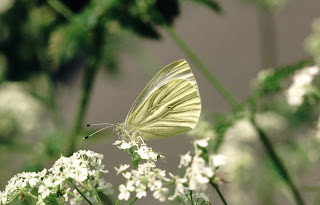
Nature breathes a sigh as the kids slowly wind their way towards a new school term. Forgotten are their woodland forays and so too my reticence of a cool cloudy August. The hottest spring and the coolest summer, how could it be otherwise. In the coppice; the acrid smell of stinkhorn fungi combine to make a memorable day, with the wonderful sight of a family of four deer browsing among the burnt coppiced chestnut. The red admiral is notable by its faded markings and ragged wings, also the speckled wood and the small white, but otherwise, it is mainly the forest birds, that are most busy, secreting stores of the abundant harvest of late summer - ahead of the approaching winter. Later in the day, on a further foray to Hayes, I saw the unexpected sight of a pair of green veined white butterflies mating.


8th September 2011

The sun has returned to remind us that it is not quite autumn, though the unexpected sight of a giant puffball, kicked apart in pieces, reminds us too that it cannot be far away and that other species of fungi will soon follow to adorn our woods.


The violent act of destruction also reminds us how deeply rooted are the primitive fears that are passed generation to generation, that fungi can spell death. Yet did they but know it, the magic, that is so often confused with the spirit in religions worldwide, owes its origins to hallucinogenic fungi and in particular the little red man; the fly agaric.


15th September

Warm sunny conditions have returned and with it a few butterflies. Cycling through the woods by Gumping Road, a speckled wood flew out to greet Gemma and I and later in Chatterton Road there was an overflying Vanessid heading South. The Jay and the nuthatch were most busy in the woods, with the autumn harvest of acorns, that this year prolifically hang in great bunches from the sagging boughs of still green oaks.

22th September

Warm sunny conditions have returned after a cooler cloudy spell of weather. There is still a hint of summer, but the butterflies are scarce, a remaining red admiral, a small white and a few speckled woods. Fruit laden boughs betoken the amazing spring, where blossom set was universally sucessful, but even the bramble has much fruit this year.

An appeal was broadcast on national radio this morning, warning of the threat to greenfinches and chaffinches of a virus that has been circulating in the UK since 2005 that has restricted the two bird species. The public are being asked to supply information if they notice sick birds. My experience is that numbers fell prior to 2010, but have picked up since - this might be temporary.


23rd September


A change of venue took me into the eighty eight acre National Trust woodland at Petts Wood. The woods are a short bike ride away and have always yielded wonderful fungi. This morning I saw the first prime fly agarics, though there were no stinkhorns that I could detect. Amanita citrina and St Georges mushrooms were also on show, but all the fungi I saw were fairly small.


25th September

A walk through the chestnut coppice at Hayes George Lane yielded several tantalizing areas in which the acrid smell of the stinkhorn lingered on the moving breeze. a few vanessids are still about - flying above head height, but mostly it is speckled woods that can be seen.

At dusk. the little owl was seen back on sentry duty in the allotment, maybe drawn from a more concealed perch to harass its arch enemy the fox, and giving off long piercing cries of anxiety and aggression at the furry intruder.